
Choosing the Best Medical Device Communication Protocol
- InnoVision Medical Technologies
- Mar 5
- 3 min read


Three standards dominate point-of-care medical device interoperability discussions: HL7v2, FHIR, and SDC. Device designers need to decide which way to go to enable rapid deployment in the market and at the same time remain viable as the market evolves. So, many device designers are trying to guess “which one wins”. The better approach might be “which one fits” the clinical and technical reality of my use case.
HL7v2 Still Dominates at the Bedside
HL7v2 remains the protocol of choice in live point-of-care workflows.
Standardized IHE Patient Care Device (PCD) profiles transformed HL7v2 from a message syntax into practical, repeatable implementation guidance that vendors and health systems can deploy across most data sets. In use for years, most hospital data consumers can easily ingest HL7v2 data.
Mature pathways for device data flow from monitors, ventilators, and infusion pumps into major EMR systems
Operationally proven alert dissemination and downstream alert handling patterns
Established support for auto-programming workflows (including scan-scan-scan medication workflows)
Repeatable cross-vendor deployment patterns due to IHE profile guidance
This maturity still translates directly into better efficiency, safer workflows, and more reliable data operations.
Where FHIR is Strong, and Where it is Still Maturing
FHIR was first published as DSTU on September 30, 2014. Its RESTful architecture and JSON/XML payload model made it a natural fit for modern distributed systems.
FHIR is especially strong for:
Cross-system demographics and context exchange
API-driven app ecosystems
Retrospective analytics and population-level workflows
At the same time, point-of-care adoption for high-frequency deterministic device workflows is still maturing in many environments.
SDC: The Momentum Is Growing
Service-oriented Device Connectivity (SDC), grounded in IEEE/ISO 11073 and strongly shaped by OR.NET, is designed for secure, bidirectional, low-latency device interoperability.
The OR.NET project began on September 1, 2012, and SDC is now moving from R&D-heavy phases into broader adoption.
• Increasing multi-vendor industry participation
• Regulatory momentum, including FDA recognition
• Continued interoperability validation through cross-vendor test events
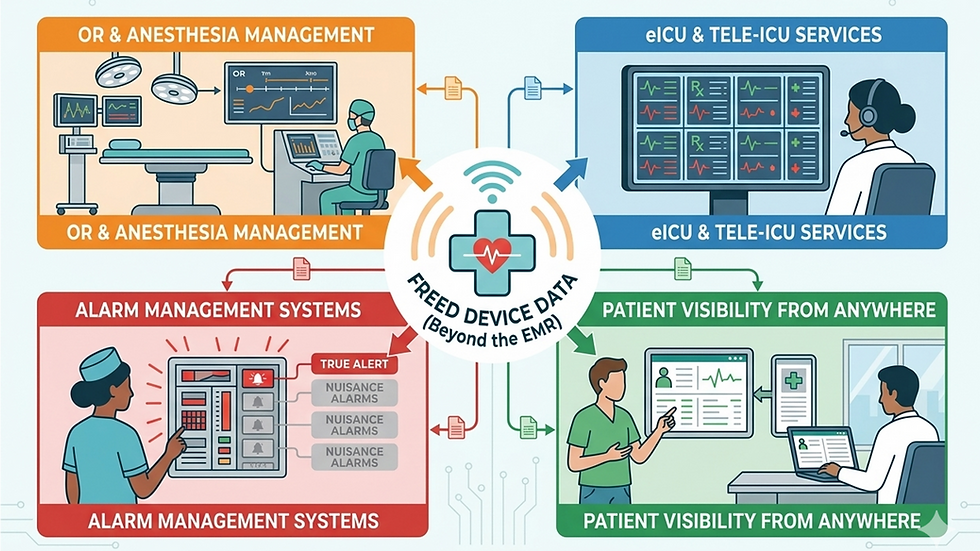
• Strong deployment focus on "Silent ICU" goals to reduce alarm fatigue and improve clinical workflow
IHE SDPi profiles further clarify deployable SDC implementation approaches in clinical settings.
Is HL7v2 Going Away?
No.
History is clear: new technology waves rarely erase established standards overnight. Mature standards persist when they continue to solve high-value operational problems.
At point of care today:
HL7v2 remains dominant for many current real-time device-to-EMR workflows
FHIR is the strategic direction for many modern API and analysis use cases
SDC is increasingly compelling for direct device-to-device coordination
The pragmatic path is to preserve durable workflow and context models above protocol details, then map to each protocol where appropriate.
The InnoVision Approach
Our approach is straightforward: encapsulate protocol-specific complexity in reusable software and gateway components and let deployments choose the best protocol per downstream requirement.
If the EMR needs IHE-aligned HL7v2, support it
If an SDC consumer needs low-latency subscriptions, support it
If a system requires FHIR-based integration, support it
This keeps customers aligned to current operational constraints without blocking modernization.
So Which Approach is Best?
There is no universal winner.
The right choice depends on the relevant clinical workflow, latency, safety requirements, system constraints, and deployment maturity.
In practice, healthcare interoperability at point of care is not HL7v2 or FHIR or SDC. It is HL7v2 and FHIR and SDC, used intentionally.
Trademark Notices: Health Level Seven, HL7, and FHIR are registered trademarks of Health Level Seven International, registered with the United States Patent and Trademark Office. IHE and Integrating the Healthcare Enterprise are trademarks of IHE International, Inc. OR.NET SDC (Service-oriented Device Connectivity) refers to a standards-based interoperability approach and OR.NET organizational initiative supporting manufacturer-independent medical device networking. 14:4


Comments